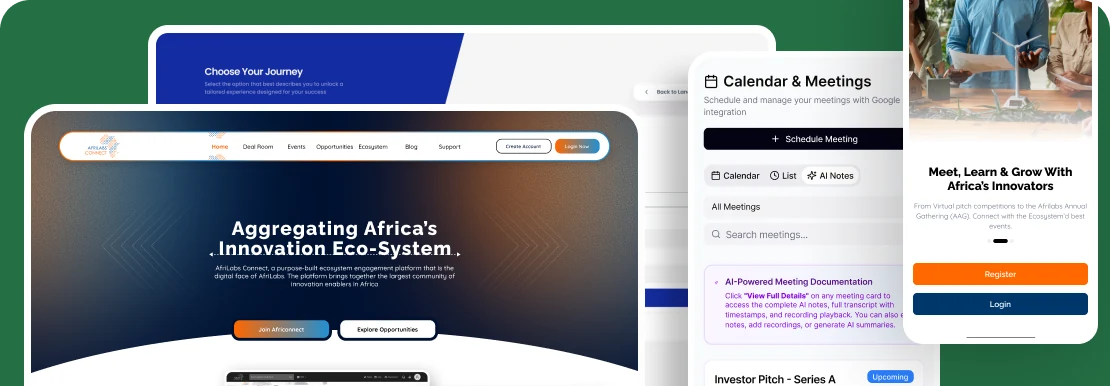
One ecosystem, two platforms
AfriLabs is a pan-African network of innovation hubs committed to supporting entrepreneurs, startups, and technology-driven communities across the continent. As Lead Product Designer, I led both the strategic and design efforts behind two interconnected platforms within the AfriLabs ecosystem.
AfriConnect a platform designed to improve discoverability, collaboration, and access to opportunities across Africa's innovation ecosystem. ACDR (AfriConnect Deal Room) a platform built to facilitate meaningful connections between startups, investors, and Business Support Organisations.
Over more than a year, I worked closely with stakeholders to transform fragmented experiences into a connected ecosystem designed to unlock opportunities across Africa and beyond.
A rich ecosystem: In Isolation
Africa's innovation ecosystem is rich with talent, ideas, investment opportunities, and support networks. Yet these resources often exist in isolation. The challenge was to design digital infrastructure capable of bridging those gaps.
Founders couldn't find opportunities
Relevant funding, mentorship, and partnership opportunities existed but were invisible to the founders who needed them most.
Investors had limited visibility
Investors struggled to identify investment-ready ventures aligned with their interests and criteria across the continent.
Hubs lacked collaboration tools
Innovation hubs lacked efficient mechanisms for cross-network collaboration, reporting, and shared learning.
BSOs couldn't coordinate
Business Support Organisations found it difficult to connect entrepreneurs with the resources and support they needed efficiently.
Bringing Africa's innovation ecosystem together
AfriConnect served a diverse range of users: founders, investors, innovation hubs, governments, corporates, development partners, researchers, and ecosystem administrators. Each stakeholder group entered the platform with different goals, expectations, and definitions of success.
Designing a coherent experience across these audiences required careful consideration of information architecture, navigation structures, and personalised pathways through the same underlying ecosystem data.
Stakeholder workshops and product strategy
Before any screens, I ran alignment workshops with AfriLabs leadership, hub managers, and ecosystem stakeholders, mapping goals, constraints, and what success looked like for each group. This shaped the product strategy that governed both platforms.
Information architecture at ecosystem scale
Managing multiple user journeys, diverse stakeholder needs, large volumes of ecosystem data, and opportunity discovery experiences required IA work done before a single screen was designed. The objective was to create clarity without oversimplifying the ecosystem itself.
Personalised pathways across stakeholder types
Each user type entered AfriConnect through an experience shaped to their role. Founders discovered opportunities and support, investors accessed ecosystem data and deal flow, hubs managed their presence and reported on activities, administrators maintained network oversight.
Discoverability as a core design problem
Poor discoverability was a root cause of ecosystem fragmentation. I designed opportunity discovery experiences that surfaced relevant content, connections, and resources based on stakeholder context, reducing the reliance on existing networks to find what already existed.
Shared design system across both platforms
AfriConnect and ACDR needed to feel like a connected ecosystem, not two separate products. I built a shared component language covering navigation, profiles, cards, data displays, and interaction patterns, consistent across both experiences.
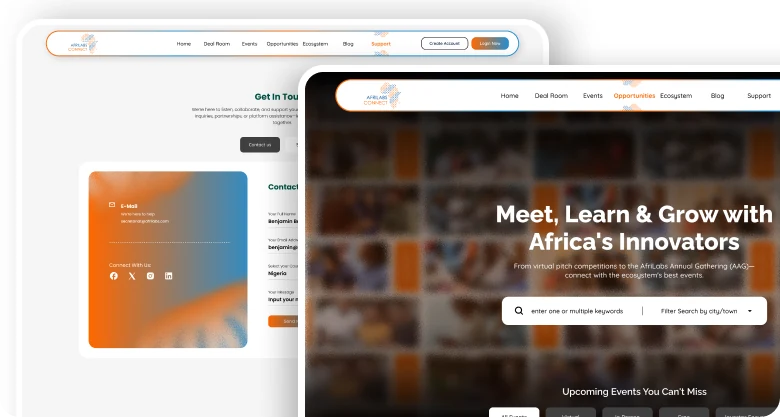
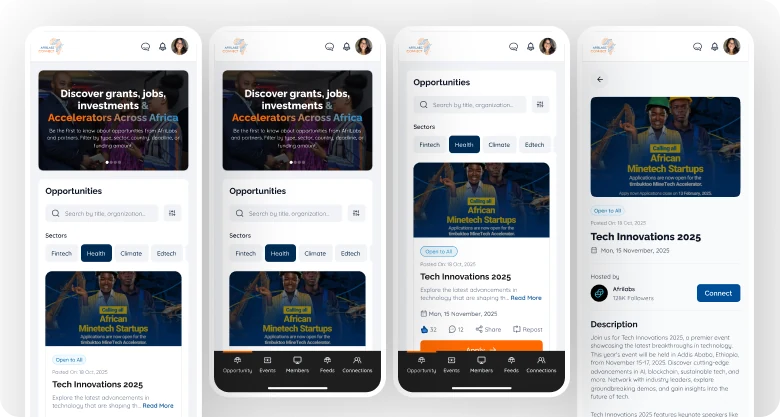
Accelerating connections between startups, investors, and support organisations
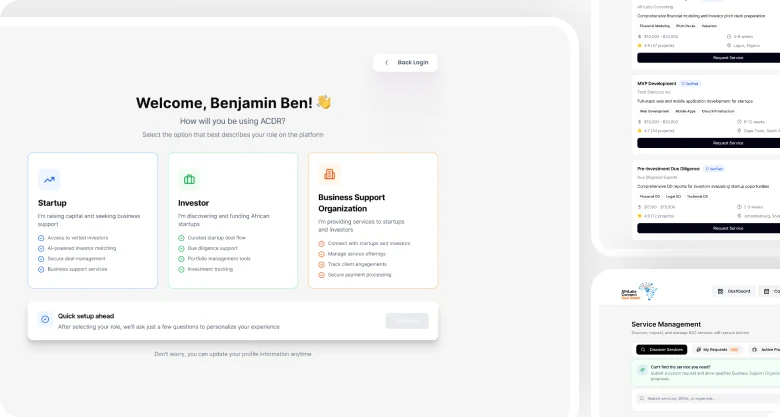
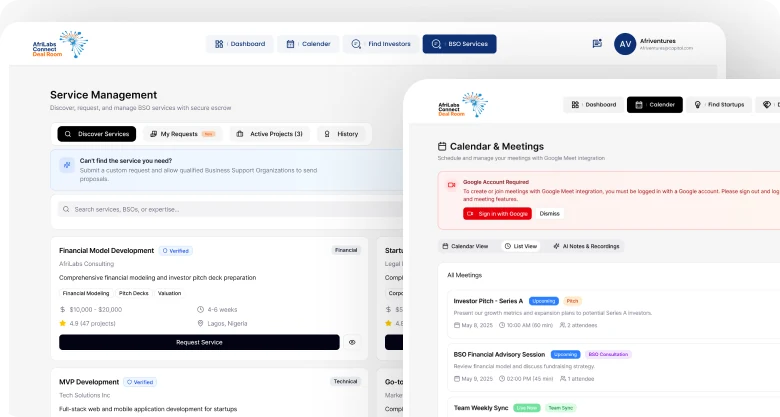
Access to capital remains one of the most significant barriers facing startups across Africa. At the same time, investors often struggle to identify investment-ready ventures aligned with their interests. ACDR was designed to reduce friction across this relationship: for startups, angel investors, venture capital firms, institutional investors, AfriLabs administrators, ecosystem partners, and Business Support Organisations.
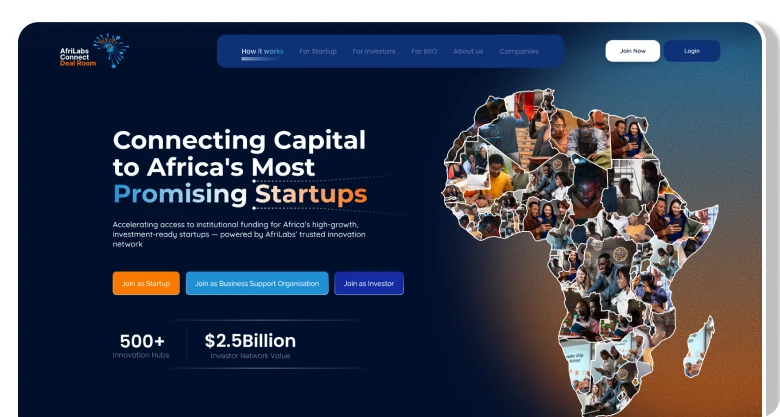
The most significant challenge was balancing the needs of founders and investors simultaneously. Founders needed visibility and equitable access to opportunities. Investors required confidence, efficiency, and access to relevant information. The platform had to facilitate trust while enabling meaningful connections.
This required careful attention to information presentation, discovery experiences, user journeys, opportunity matching, and decision-support, designing each stakeholder's path so that a connection initiated by one side felt natural and credible from the other.
Impact
The AfriLabs ecosystem delivered measurable value across its stakeholder groups, with increased platform adoption, reduced friction across ecosystem workflows, improved opportunity discoverability, and stronger connections between ecosystem participants.
Beyond metrics, the ecosystem created new pathways for startups, investors, and support organisations to engage more effectively. AfriConnect gave the network a shared digital home. ACDR gave its most critical relationships: between capital and founders, a structured, trusted environment to develop.
Together, the two platforms transformed a fragmented, informal ecosystem into a connected digital infrastructure, making innovative, technological, and economic opportunities more accessible across Africa and the world.
What this project changed
The AfriLabs ecosystem fundamentally changed the way I think about product design. Designing at ecosystem scale requires moving beyond individual interfaces and considering how relationships, incentives, and information flow through an entire network.
The challenge is not simply usability. It is coordination. Success depended on understanding the motivations of diverse stakeholders and creating experiences that aligned those interests without compromising the integrity of the ecosystem itself.
This project strengthened my ability to lead strategic conversations, navigate complexity, and design products capable of enabling meaningful interactions at scale.